
Rotary hammer or impact drill: which one to use for drilling concrete?
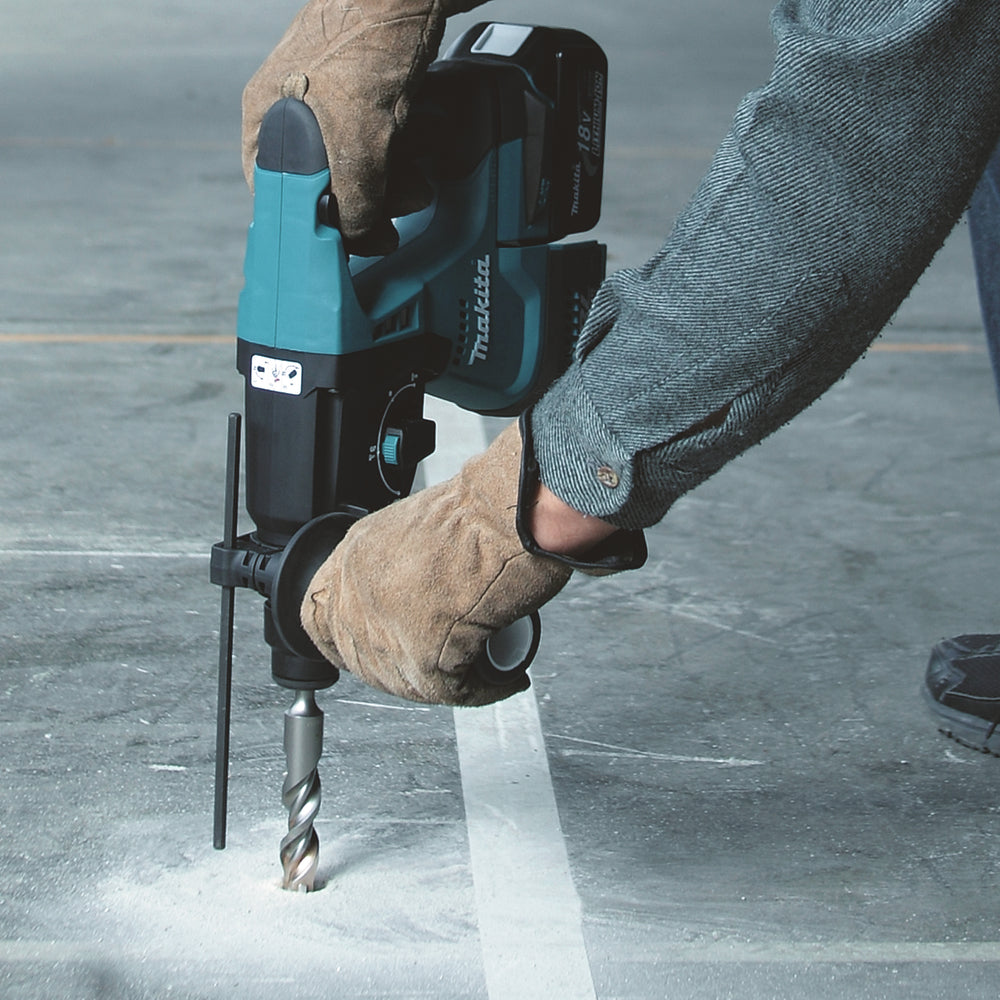
A rotary hammer is best suited for drilling into concrete because its impact is powerful (about 1–4 J for Makita SDS-plus models), whereas a hammer drill hits frequently but weakly. A hammer drill is the best choice if you only drill into stone rarely and for small holes.
For drilling into concrete, choose a rotary hammer. A rotary hammer strikes fewer times per minute, but each strike is powerful (about 1–4 J for Makita SDS-plus rotary hammers), while a hammer drill strikes very frequently but with little force. A hammer drill is sufficient if you are drilling only a few small holes into concrete or brick.
What is the difference between a rotary hammer and a hammer drill?
In a hammer drill, two serrated discs rub against each other. The chuck moves slightly back and forth at each tooth. The impact rate is high; for example, the DHP482Z delivers up to 28,500 impacts per minute. Each strike is small, however, and the force is provided mainly by your hand. Makita does not state the impact energy in joules for hammer drills.
In a rotary hammer, a piston compresses air, and the air flings a striker against the end of the drill bit. The impacts are less frequent but strong. For example, the DHR242Z delivers 2.0 J and up to 4,700 impacts per minute. The drill bit itself crushes the concrete; you only guide the tool. The work is faster and your hand gets less tired.
Impact energy (J) or impact rate – which is more important?
For concrete, impact energy, i.e., joules (J), is more important. A high impact rate without impact force does not help against hard concrete. The higher the impact energy, the faster the drill bit enters and the larger the holes you can make. The data below is from Makita's technical specifications.
| Tool | Impact energy | Impacts per minute | Concrete: suitable / max |
|---|---|---|---|
| DHP482Z 18V Hammer Drill | not specified | 0–28,500 | – / 13 mm |
| HR140DZ 12V CXT Rotary Hammer | 1.0 J | 0–4,900 | 3.2–10 / 14 mm |
| DHR183Z 18V LXT Rotary Hammer | 1.7 J | 0–5,000 | 3.2–10 / 18 mm |
| DHR242Z 18V LXT Rotary Hammer | 2.0 J | 0–4,700 | 4–16 / 24 mm |
| HR2630J Rotary Hammer, 800 W | 2.4 J | 0–4,600 | 4–18 / 26 mm |
| HR009GZ 40V XGT Rotary Hammer | 3.9 J | 0–4,500 | 8–22 / 30 mm |
"Suitable" is the diameter at which the tool works best. At maximum, the work is already slow.

SDS-plus or SDS-max: what is the difference?
SDS is the drill bit mounting system. The bit is pushed into the chuck and locks automatically; there is no need to turn anything. The drill bit can move slightly back and forth in the chuck, which directs the impact straight to the bit.
- SDS-plus: shank diameter 10 mm. Light and medium-duty rotary hammers, holes about 4–30 mm. Most home and construction work.
- SDS-max: shank diameter 18 mm. Heavy-duty tools for large holes and heavy chiseling. For example, the demolition hammer HM1213C provides 18.6 J.
SDS-plus and SDS-max drill bits are not interchangeable. An SDS bit also does not fit into a standard drill chuck.
What size holes can be drilled into concrete?
- 5–8 mm (anchors for shelves, curtain rods, pictures): hammer drill is suitable, rotary hammer is faster.
- 8–16 mm (anchors, cable conduits): 18V SDS-plus rotary hammer.
- 16–30 mm: rotary hammer 2.4–4 J, e.g., HR2630J or HR009GZ.
- Holes for electrical outlets and boxes: TCT core bit. According to Makita, up to 54 mm (DHR242Z), 68 mm (HR2630J), or 80 mm (HR009GZ).
- Larger holes: SDS-max rotary hammer or diamond drilling. Ask for advice in the store.
You can find SDS-plus drill bits of various lengths on the drill bits and bits page.
Can you also chisel with a rotary hammer?
Many rotary hammers have an "impact only" mode. In this mode, the drill bit does not rotate, and you can use a chisel to remove tiles, make cable grooves, or break small pieces of concrete. Check the technical specifications to see if it lists "chiseling". For example, the DHR242Z and HR2630J can chisel. Some compact models only have drilling and hammer drilling.
If you only need to chisel, choose a demolition hammer. The DHK180Z is an 18V SDS-plus demolition hammer (3.1 J). For heavy demolition work, use SDS-max demolition hammers, such as the HM1213C (18.6 J, 10.8 kg).
When is a hammer drill enough?
A hammer drill is a good choice if all of the following apply:
- You drill into concrete rarely, just a few holes at a time.
- The holes are small, up to about 8 mm.
- The wall is brick or lighter material, not dense monolithic concrete.
- The main work is driving screws and drilling into wood or metal.
If the drill bit gets stuck, overheats, or the hole is not progressing, it is time for a rotary hammer.
How to drill into concrete with a rotary hammer?
- Put on safety glasses and, if necessary, ear protection. Concrete dust is fine; use a vacuum cleaner or dust guard.
- Check that there are no wires or pipes in the wall before drilling.
- Select the "hammer drilling" mode and set the depth gauge to the length of the anchor.
- Start slowly until the bit is set in the surface. Then use full speed.
- Press lightly. Excessive pressure weakens the impact and heats up the drill bit.
- For deep holes, pull the bit out occasionally to clear the dust from the hole.
- If the drill suddenly stops, you may have hit reinforcement bars. Do not force it further.

Who is it for?
- Choose a hammer drill if you need one tool for screws and occasional holes in stone. View drills.
- Choose an 18V SDS-plus rotary hammer (1.7–2.0 J) if you drill into concrete in an apartment or house regularly and you already own Makita 18V LXT batteries.
- Choose a 2.4–4 J rotary hammer (mains-powered or 40V XGT) if you drill every day, make large holes, or use a core bit for electrical boxes.
- Choose a demolition hammer if the main work is chiseling and demolition.
- Rent the tool if the job is a one-time thing. View rentals.
You can find all rotary hammers and demolition hammers on the rotary hammers page. If you are not sure what is suitable, come to our store at Pärnu tn 8 in Paide – we will help you choose the tool and the right drill bit.
Frequently asked questions
Kas SDS-plus puurvasaraga saab puurida ka puitu ja metalli?
Jah, kui lülitad löögi välja. Tavaliste puuride jaoks on vaja SDS-plus adapterit koos padruniga. Täpsemaks tööks puidus ja metallis on trell siiski mugavam.
Kas akupuurvasar on sama hea kui võrgutoitega puurvasar?
Enamiku tööde jaoks jah. 18V DHR242Z annab 2,0 J ja võrgutoitega HR2630J 2,4 J. Raskeks tööks on 40V XGT puurvasar HR009GZ (3,9 J).
Miks puurvasar ei puuri, kuigi mootor töötab?
Kontrolli, et režiimilüliti on löökpuurimise asendis ja puur ei ole nüri. Ära suru liiga kõvasti, sest puurvasar töötab kõige paremini kerge survega.
Kas gaasbetooni puurimiseks on vaja puurvasarat?
Tavaliselt ei. Gaasbetoon on pehme, seega puuri ilma löögita, et auk ei läheks liiga suureks.
Sources
Technical data comes from the manufacturer's official product pages:
Shop the products
Need advice? Visit our store (Pärnu tn 8, Paide) or write to us.